Inside John Thune’s arithmetic
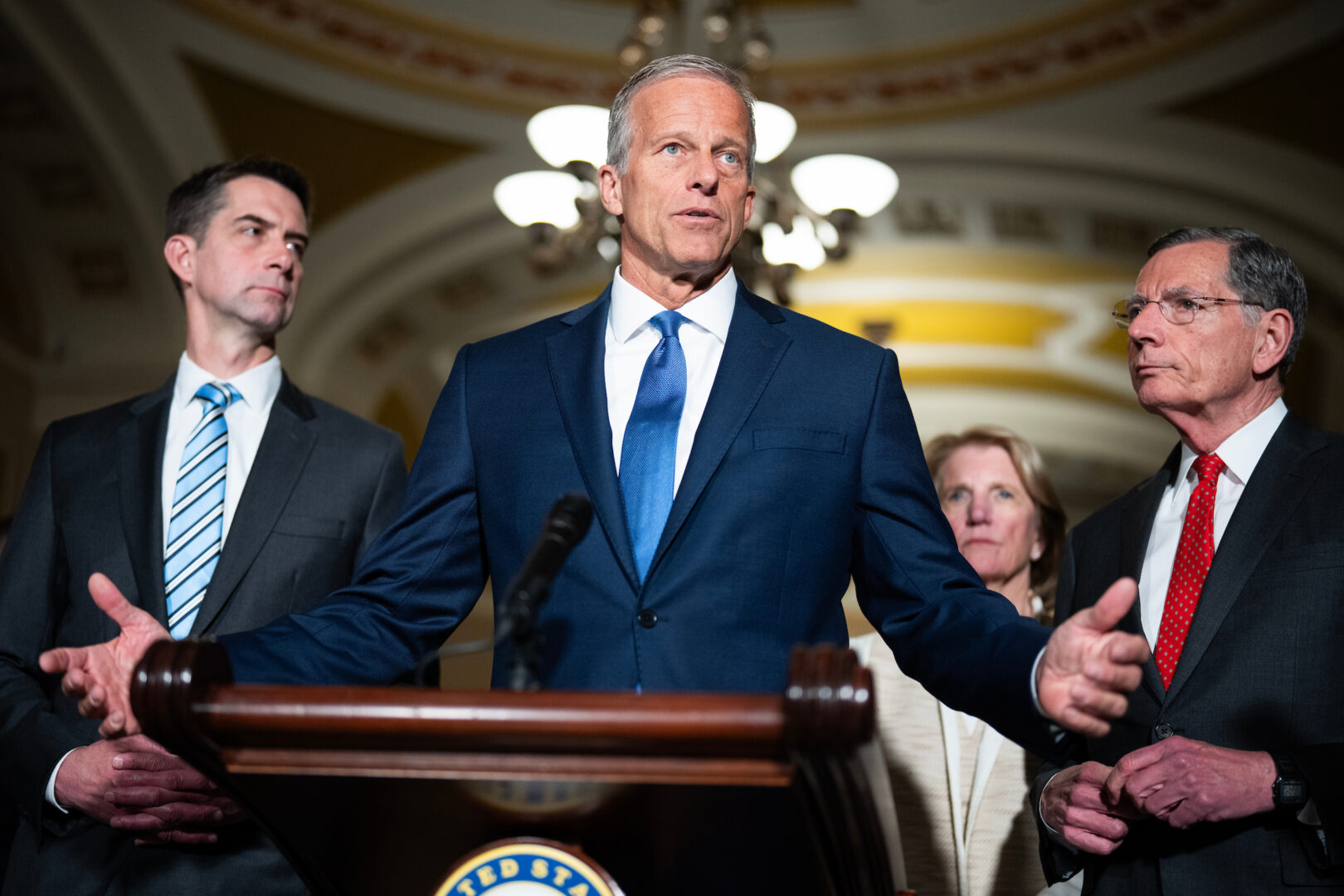
John Thune is rubbing his jaw, one of his telltale signs he’s tired.
What should’ve been a week of celebration after muscling through his party’s second budget reconciliation package as Senate majority leader — nearly a year and a half into his tenure — was instead spent navigating hurdles set by the other end of Pennsylvania Avenue.
Read more Reconciliation 3.0 hurdles
“There are a lot of things you just don’t control, and timing of White House announcements is one of them,” Thune, 65, said Thursday afternoon, as he settled into a plush chair in the Republican leader’s suite in the Capitol.
That’s becoming something of a pattern from the White House, complicating a careful leadership calculus for Thune.
Just minutes before the South Dakotan sat down for an interview, President Donald Trump had just thrown another obstacle his way: his announcement of Jay Clayton as nominee for director of national intelligence.
It wasn’t Trump’s pick, but the timing; that announcement came just as the Senate was leaving town, and hours after the House had finished votes for the week. Had it come earlier, it might’ve provided a window to help congressional Republicans extend a key spy powers authority as its expiration loomed.
Thune told reporters in the hall that he “hadn’t heard” ahead of the president posting it on Truth Social, adding later in his office he hadn’t spoken with the president in a few days. He also hadn’t attended a White House bill signing event the day before to tout the reconciliation bill. Instead, he spent the week dealing with the spy powers saga.
Things could have been a whole lot simpler had Trump never named the controversial Bill Pulte as acting DNI earlier this month, leading Democrats to back away from a bipartisan reauthorization of what’s known as section 702 of the Foreign Intelligence Surveillance Act.
“Some of the things that have happened the last few weeks have completely thrown a wrench into our ability to execute,” Thune acknowledged. “It has been particularly challenging.”
Despite that, Thune has largely kept his conference united — no small feat with his slim 53-47 majority.
By Thursday afternoon, Senate Republicans had already moved ahead quickly with Trump’s less incendiary pick of Clayton, setting confirmation hearings for this week. That long-suffering resilience from Thune — paired on the flip side with his willingness to stand firm as a Senate firewall even when it irks the president — has worked out pretty well for him, at least legislatively speaking.
His wins include the first rescissions package of its kind signed into law in 30 years, not to mention those two budget reconciliation bills. He successfully shepherded six “vote-a-ramas” this Congress — an unusually high number — in which no Democratic amendments were triumphant.
“For the most part our members buy into the idea that we are a team. If we’re going to succeed, we’ve got to succeed together, and that means sometimes holding hands and just doing hard things,” Thune said.
Sen. Shelley Moore Capito, a West Virginia Republican who serves in leadership with Thune as chair of the Republican Policy Committee, said he’s “a sports guy, and I think he knows you have to be patient and wait it out to look for your right opportunity.”
“He does reach a point where he’s got to rip the Band-Aid off and go forward. I think he was mystified as to how the White House is kind of injecting into different issues,” Capito added.
Case in point: The administration announced a Department of Justice “anti-weaponization fund” last month right as a vote-a-rama was approaching, irritating Republicans enough that Thune was forced to delay it. And Trump primaried Sens. John Cornyn of Texas and Bill Cassidy of Louisiana out of their seats, alienating two very much needed “yes” votes for Thune and the president.
Several of his colleagues cited the rescheduled vote-a-rama as an example of Thune’s balancing act with the White House: He and his whip team had to appease Cassidy on the Senate floor — the leader regularly rubbing his temples, another one of his telltale signs of stress — while also hearing from the president more than once during the 18-hour voting spree.
Still, Thune mostly kept the team together to pass the reconciliation bill. Alaska Sen. Lisa Murkowski was the sole Republican to oppose the final measure, and Cassidy ended up supporting it, even after an amendment he pushed for fell short.
“Now even more so with the primaries now behind us, we’ve got a few more free agents — and a 53-seat majority that’s now more like 46,” Thune said.
‘Arithmetic’
There remains one undeniable fact in Thune’s mind: math is math.
Before he was leader, he served as the Republican whip for former Leader Mitch McConnell, where he learned how to “see the whole theater.” He knows that for several of Trump’s demands, the numbers simply aren’t there.
That’s true not only for the GOP’s marquee voter ID and election overhaul bill, known as the SAVE America Act, but also for the White House’s wish to scrap the legislative filibuster to get it through the Senate.
“His priorities are going to be to nuke the filibuster, pass the SAVE Act, fire the parliamentarian,” Thune said of Trump. “I’ve indicated to him in most cases — not all — that what he wants done, we just don’t have the votes for, and there’s nothing I can do to change that.”
Asked recently by reporters if he feared Trump could criticize his leadership if he didn’t do what the president wanted, Thune chuckled. “That could happen,” he replied.
The voter ID bill in particular keeps stirring up backlash for Thune as online MAGA world presses him to pass it: “Obviously, I take fire from all sides.”
But Cornyn, who told the New York Times his recent loss gives him more “freedom, and certainly leverage,” has been publicly sparring with Sen. Mike Lee, telling his Republican colleague from Utah to stop blaming Thune for SAVE’s stalling.
“You don’t have the votes,” Cornyn posted on X, writing that Thune “can’t change that.”
During the recent vote-a-rama, Republicans pushing the legislation couldn’t even muster a GOP show of unity on a SAVE-related amendment. A previous extended debate was essentially abandoned earlier this year as well following lackluster floor time.
Trump’s “got a passion for it, which I understand,” Thune said, but “it comes down to arithmetic.”
On Sunday the president tossed up yet another hurdle, posting he’s “against FISA if it doesn’t come with The Save America Act (Full version!) firmly attached to it.”
Read more Fight night: FISA and beyond
Reconciliation 3.0?
Budget reconciliation is one lever Thune has pulled to get his job done — first to advance Republicans’ agenda with 1.0, better known as the One Big Beautiful Bill, and then to work around Democrats’ appropriations blockage with a “skinnier” 2.0 package that provided $70 billion to fund immigration enforcement agencies for the rest of Trump’s term.
Thune is keeping the door cracked open for another such bill that bypasses the Senate’s 60-vote threshold, but pointed to a tight schedule ahead of the midterms and growing skepticism among his conference.
Trump last week called on Republicans to “IMMEDIATELY advance and pass” a $350 billion defense reconciliation bill that “will include THE SAVE AMERICA ACT as well.”
Both Senate Appropriations Chair Susan Collins, R-Maine, and McConnell, the Defense subcommittee chairman, had said they don’t believe a third reconciliation bill will happen and the administration shouldn’t rely on it for more defense-related funding.
The “appetite” of the conference depends on the bill’s ingredients, Thune said, adding “the danger in a recon 3.0 is that it implicates more committees of jurisdiction” and gives Democrats another chance to lob amendments trying to “undo” the GOP’s work so far.
Most Republicans “are willing to support a higher topline number for the military,” he said. “But whether or not reconciliation is the vehicle to achieve that? I don’t have an answer for that yet.”
Midterms
At the center of the defense-boost push is the Pentagon’s quickly depleting munitions stockpile thanks to the war in Iran, which has surged well beyond the 100-day mark.
While a ceasefire deal was announced Sunday by the White House, the conflict has set off sirens for Senate Republicans ahead of the midterms as gas prices remain high and as Trump hemorrhages support from key groups.
Eight years ago, Trump’s job approval rating created a tough national political environment for Republicans, but they gained two seats in the Senate while losing more than 40 in the House. This time, even if the 2026 Senate map still benefits the GOP, Democrats are growing increasingly bullish.
Senate Democratic Leader Charles E. Schumer, D-N.Y., told Punchbowl News they had “multiple paths” back to power, citing Texas as an unexpected boon after Trump endorsed the scandal-plagued Ken Paxton over Cornyn.
Thune and the National Republican Senatorial Committee had hoped to avoid such intra-party drama — pleas that went ignored as the president has continued to put his finger on the political scale.
“This is not a normal political environment, and there’s a lot of anger out there,” Thune admitted. “I don’t think this is the kind of year, Democrat or Republican, where you’re going to be able to win an election by trying to get people to have a warm, fuzzy feeling about you.”
Still, as Republican candidates get out on the campaign trail this summer, Thune is hoping to refocus on the “One Big Beautiful” law — now branded as the Working Families Tax Cuts — and other legislative feats.
“We have quality candidates. We have, I think, a record of accomplishment that we can run on that’s pretty compelling,” Thune said.
“There’s something coming out of the White House on a daily basis that keeps life interesting,” he added. “When you’ve got a cycle where you’re facing not only political headwinds [but] some economic headwinds … you have to be adaptable.”
That’s a lesson he keeps returning to — there are “things you can’t control.”
‘Coach or point guard’
Thune doesn’t necessarily relish holding the blame stick in the eyes of MAGA influencers, but he also doesn’t mind it: “Sometimes they’re mad at the president, sometimes they’re mad at the Congress, and I obviously generate a lot of ire in my direction these days.”
A former high school and college basketball star, Thune has returned to that sportsman-like mentality in his tenure, viewing himself as “the coach or the point guard.”
“You distribute the ball to the people that can score it,” he said. During our 30-minute conversation, the black smart watch on his wrist lit up more than once with members calling him.
Several colleagues described him as sticking to the same personality, whether behind closed doors, in their weekly policy luncheons, twisting arms on the Senate floor, or sounding off during “Squawk Box” appearances.
Senate Majority Whip John Barrasso, R-Wyo., said Thune has done well in a “demanding position,” adding “in the face of unprecedented Democrat obstruction, a united front matters more than ever.”
Back when he was campaigning for the role, part of Thune’s pitch was to get the Senate “working again” and protect its traditions. “Democrats have tested that proposition a lot this year,” Thune said, leading him to “seize” on the opposing party’s earlier idea to pass executive nominees in tranches to avoid procedural delays. Using “reconciliation to fund the government,” as with the bill the president signed last week, was another workaround after Democrats balked at Department of Homeland Security funding amid outrage over the agency’s tactics.
“We’re doing things I never thought we’d have to do, but you’ve got to be creative,” he said.
Thune listed several bipartisan bills he’d like to tackle in the remaining weeks of the legislative year, pointing to a crypto package that recently advanced out of committee, a transformative college sports bill backed by the president and a farm bill the House recently passed.
“The question is to what level are Democrats going to participate. What’s the appetite in an even-numbered year, where the political overtones tend to take hold?” he asked. “The Senate is designed to be a non-majoritarian body to give voice to the minority in the country.”
For Thune, the task now is keeping a steady hand even as one surprise after another comes his way. As he braces for the final stretch before the midterms, the massive windows in his office overlook construction on the National Mall, the humid June sun illuminating preparations for the upcoming Great American State Fair to mark the country’s 250th birthday.
Despite his trying week, Thune still cracks a joke about country singer Martina McBride and other artists dropping out of the 250th concert and the meaning of her song “Independence Day.”
“Got to find joy when you can,” the Republican leader says of his dad-humor. “There’s not much joy in the job these days.”
Read more Rogers earmarks money for nonprofits he helped launch